The Employment Rights Act is Now Law: Key Changes, Crucial Dates, and Your Action Plan.

- By Harri Insider Team | January 6, 2026
As we step into 2026, the legislative landscape for hospitality has officially shifted. What was once the “Employment Rights Bill”, a subject of much debate and preparation on the Harri blog over the last year, has now received Royal Assent to become the Employment Rights Act 2025.
For hospitality operators, the message is clear: The period of “wait and see” is over. This isn’t just a list of proposals anymore; it is the law of the land. While many of the changes will be phased in over the coming months and years, the complexity of these reforms means that if you wait until the implementation dates to act, you’ll already be behind.
Here is exactly what passed, how it impacts your venues, and the timeline you need to be working towards.

What Exactly Was Passed?
The final Act contains several landmark shifts that will fundamentally change how hospitality businesses hire, schedule, and manage their teams.
1. The End of the Two-Year Wait for Unfair Dismissal
This was the most contested part of the Bill. While the government initially proposed a “Day One” right, the final Act settled on a six-month qualifying period.
The Change: Employees will now have the right to claim unfair dismissal after just six months of service (down from two years).
The Sting: The statutory cap on compensation for unfair dismissal has been removed. This means a claim could now result in uncapped financial awards, making the cost of a “bad hire” or a poorly managed exit significantly higher.
2. The Right to Guaranteed Hours
The Act targets “one-sided flexibility.”
The Change: Workers on zero-hour or low-hour contracts will have a right to a contract with guaranteed hours that reflect what they actually work over a reference period (likely 12 weeks).
Predictability: Operators must now provide reasonable notice for shifts and, crucially, pay compensation for last-minute cancellations or changes.
3. Day-One Statutory Sick Pay (SSP)
The “waiting days” are gone.
The Change: SSP will be payable from the first day of illness, removing the previous three-day waiting period. The Lower Earnings Limit has also been removed, making almost all part-time and lower-paid staff eligible for sick pay immediately.
4. A Higher Bar for Sexual Harassment Prevention
The duty has shifted from taking “reasonable steps” to taking “all reasonable steps” to prevent sexual harassment.
Third-Party Liability: Crucially for hospitality, employers can now be held liable for harassment of their staff by third parties, such as customers or delivery drivers, if they haven’t taken the necessary preventative measures.
5. Flexible Working as the Default
The Change: Flexible working is now a day-one right. While you can still refuse a request, you must now justify that refusal as reasonable and explain the rationale to the employee.

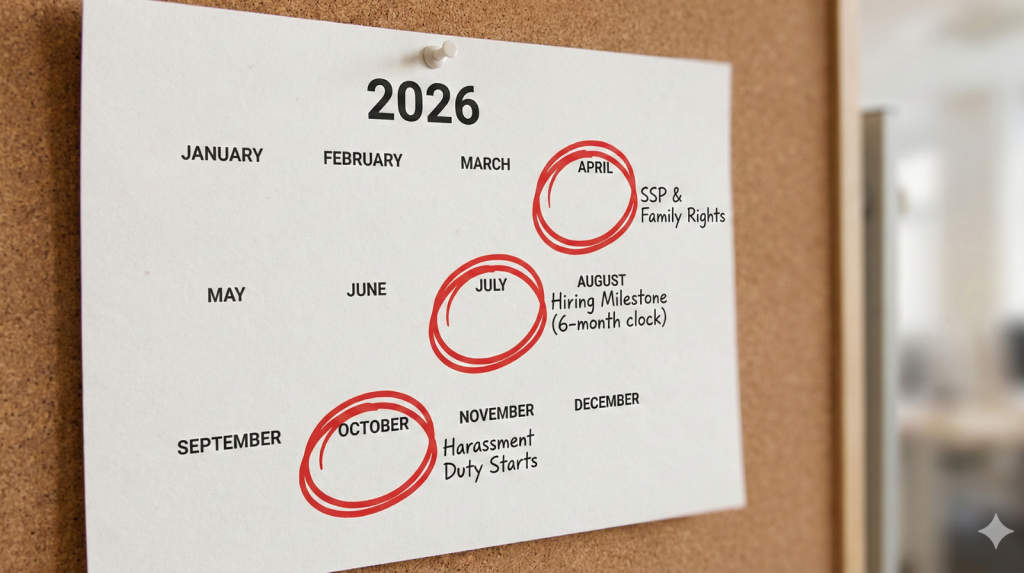
Dates for your Diary
April 2026SSP & Family Rights: SSP becomes a day-one right. Paternity and bereavement leave also become day-one rights.
July 2026The Hiring Milestone: Anyone hired from this date onwards will reach their 6-month mark just as the new unfair dismissal protections kick in.
October 2026Harassment & Tipping: The “all reasonable steps” duty begins, alongside tighter regulations on tipping transparency.
January 2027The Big Shift: The 6-month unfair dismissal right officially takes effect. The removal of the compensation cap also applies.
Don’t Put It Off: Start Thinking Today
In our previous content, we discussed the “Why”—now we must focus on the “How.” Hospitality relies on agility, but the Employment Rights Act 2025 demands structure.
1. Audit Your Contracts Now Do your contracts reflect the new rules on guaranteed hours? Are your probationary periods robust enough to make a performance decision within six months? If you’re still using 2024 templates, you’re at risk.
2. Modernise Your Scheduling With the requirement to pay for last-minute shift cancellations, “manual” or “reactive” scheduling will become a massive financial drain. You need systems that track reference periods and alert managers to potential compliance breaches before they happen.
3. Train Your Managers on Documentation With unfair dismissal protection starting at six months and uncapped awards on the table, the “informal chat” is no longer enough. Your frontline managers must be experts at documenting performance and following fair processes from week one.
4. Review Your “Third-Party” Risk Does your venue have clear signage and policies stating that harassment from customers will not be tolerated? Under the new “all reasonable steps” duty, you need to prove you’ve protected your staff from the public, not just from each other.
How Harri Can Help: US-Tested, UK-Ready
Navigating the Employment Rights Act 2025 is a major operational shift, but it is one Harri was built to handle. For over a decade, we have supported US operators in high-compliance markets like California and New York, where “Fair Workweek” laws already mandate 14-day advance notice, predictability pay for last-minute changes, and “Right to Rest” periods.
The UK’s new rules on guaranteed hours and shift penalties are effectively a “facsimile” of the regulations Harri has already mastered. Because our platform was designed for these strict standards, we offer a “ready-now” solution for the UK:
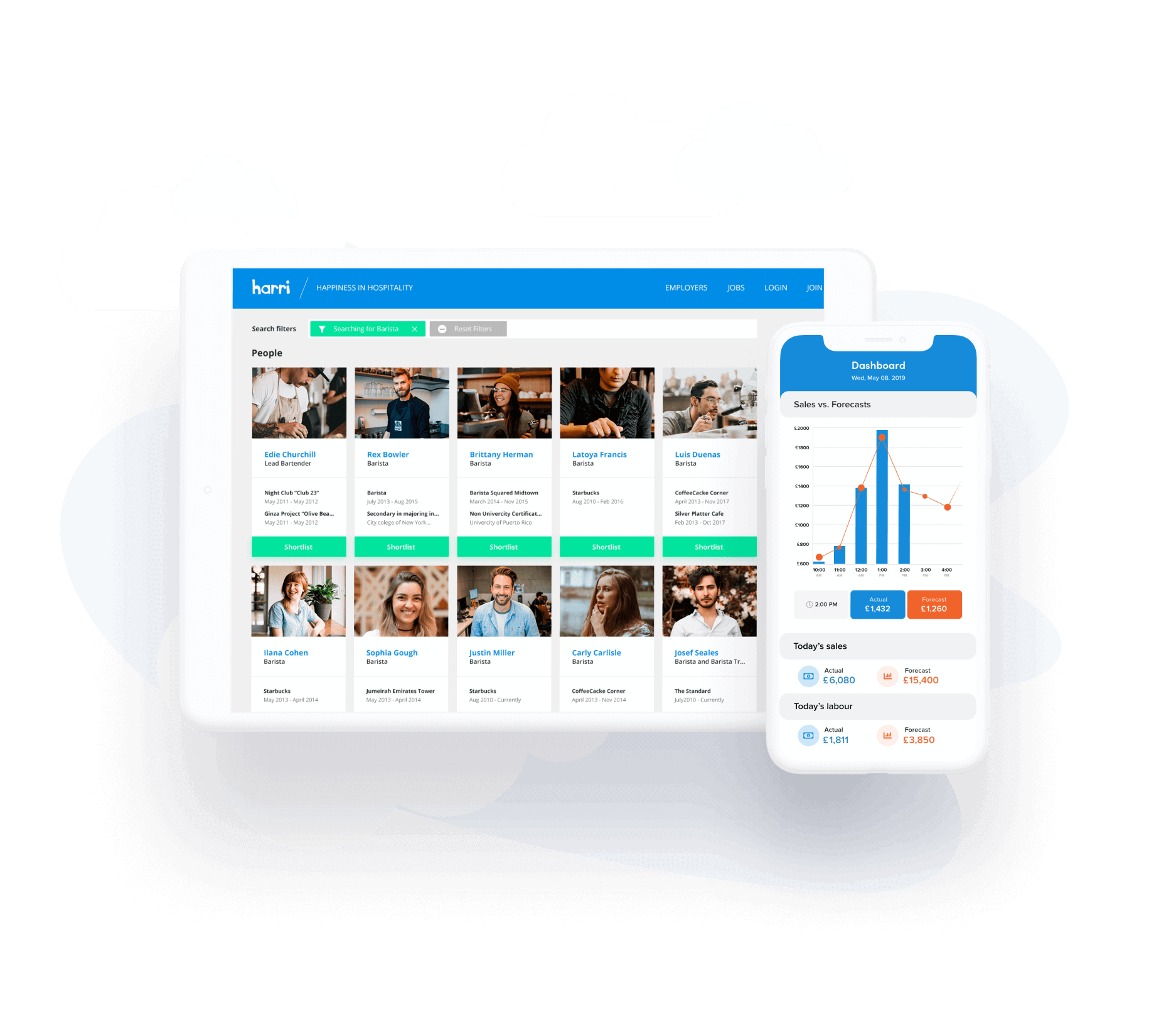
Compliance-Driven Scheduling: Our intelligent engine automatically tracks reference periods and alerts managers to potential “Fair Workweek-style” violations before they occur.
Automated Training & Onboarding: Ensure every employee completes harassment prevention modules before they can even clock in for their first shift.
Digital Audit Trails: From shift swaps to premium payments, Harri maintains permanent digital records, providing the “compliance proof” required under the new Act.
- AI-Powered: The entire Harri suite is powered by Agentic AI. Designed to support all levels across the business through recruitment, scheduling & compliance, and employee engagement.
If you need to know more about the Employee Rights Act, or how Harri can support your business through the changes, then get in touch today.